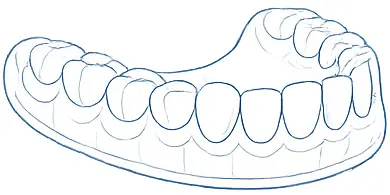
A complete denture replaces every tooth within the upper or lower arch. The restoration rests over the healed gums and is shaped to use the available anatomy for support, stability, and retention.
The upper arch usually provides a broader surface area for support because the denture can extend across the palate. The lower arch may be more challenging because the tongue, cheeks, and floor of the mouth move constantly during speaking and eating.
Accurate impressions or digital records capture the shape of the gums and supporting tissues. Bite measurements are also needed to determine how the upper and lower dentures should meet and how much vertical support should be restored.
The replacement teeth are arranged according to facial proportions, lip support, smile line, speech, and chewing relationships. Small variations in shape and position can help the completed restoration appear more natural.
Although a complete denture restores appearance and function, it does not reproduce the full strength or sensation of natural teeth. Patients generally need time to adjust food choices, chewing technique, and daily care.
A partial denture replaces selected missing teeth while preserving healthy natural teeth that remain within the arch. The restoration fills open spaces and helps maintain the position of neighboring teeth.
Partial dentures may use a metal framework, flexible material, acrylic base, precision attachments, or another design selected according to the location of the missing teeth and condition of the supporting structures.
Clasps or attachments help the denture remain in place during speaking and chewing. Their position is planned carefully to provide stability while limiting unnecessary pressure on the supporting teeth.
The remaining natural teeth must be healthy enough to support the restoration. Cavities, gum disease, loose teeth, or failing restorations may need treatment before the final partial denture is created.
A partial denture should be removed for cleaning and according to nighttime instructions. Food and plaque can collect beneath the base and around the supporting teeth if daily hygiene is inconsistent.
An immediate denture is prepared before the remaining teeth are removed and inserted shortly after the extraction procedure. This allows the patient to leave with replacement teeth rather than waiting through the initial healing period without a denture.
The immediate restoration can help protect extraction sites, support appearance, and maintain a degree of function during healing. However, the final fit cannot be predicted as accurately because the denture is created before the teeth are removed.
The gums and bone change significantly during the first several months after extraction. As swelling decreases and the tissues reshape, the immediate denture may become loose or develop pressure areas.
Adjustments, temporary liners, and later relining may be required as healing progresses. A new final denture may eventually be recommended when the tissues have become more stable.
Patients should follow all extraction and denture instructions carefully. The restoration may need to remain in place for a specific period immediately after surgery so swelling does not prevent reinsertion.
Dental implants can provide additional stability for selected removable dentures. The denture connects to attachments placed on implants within the jaw and can be removed by the patient for cleaning.
Implant support can reduce movement during chewing and speaking, particularly for lower dentures that have limited natural retention. The restoration may feel more secure because it snaps or clips onto the implant attachments.
The number of implants depends on the jaw, available bone, denture design, bite pressure, health history, and desired level of support. A removable implant overdenture has different requirements than a fixed full-arch restoration.
Implants do not eliminate the need for denture maintenance. The restoration still requires cleaning, and the gums and implant attachments must remain free of plaque and inflammation.
Attachment components can wear over time and may require periodic replacement or adjustment. The denture base may also need relining as the surrounding tissues change.
Dentures rest on tissues that naturally change over time. Bone gradually remodels after tooth loss, and changes in weight, health, medications, and oral tissues may also affect fit.
A denture reline updates the surface that contacts the gums. New material is added to improve adaptation without replacing the complete restoration when the teeth, bite, and base remain otherwise acceptable.
A soft liner may be used temporarily when tissues are tender or healing. A more durable hard reline may be recommended after the mouth has reached a stable condition.
Adjustments remove pressure from specific sore areas or refine the bite. Patients should not attempt to reshape the denture at home because uncontrolled grinding can permanently damage the fit.
A reline cannot correct every problem. A severely worn, cracked, unstable, or poorly designed denture may require complete replacement instead.
Dentures experience daily wear from chewing, cleaning, temperature changes, and repeated removal. The replacement teeth may flatten, the base may develop small cracks, and the fit may change as the gums and bone reshape.
A worn bite can reduce chewing efficiency and alter the support provided to the lips and cheeks. The lower face may appear shorter when the denture teeth have lost significant height.
Older dentures may also collect stains and surface scratches that become difficult to polish completely. Rough areas can retain plaque, odors, and microorganisms more easily.
Dr. Vo evaluates fit, bite, appearance, tissue health, and structural condition before recommending repair, reline, or replacement. Continuing to wear a poorly fitting denture can contribute to chronic soreness and instability.
A new denture may be based on successful features of the previous restoration while improving tooth position, bite, support, and overall fit.