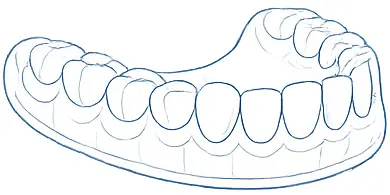
Crowding occurs when there is not enough space for the teeth to align within the dental arch. Teeth may overlap, rotate, or erupt outside the ideal curve.
Invisalign can create and distribute space through planned tooth movement. Some cases may also involve slight enamel reshaping between teeth or expansion of the dental arch.
The amount and location of crowding influence treatment length. Rotated teeth and areas with limited bone support may require slower or more controlled movement.
Improving crowding can enhance smile appearance and make brushing and flossing more manageable between previously overlapping teeth.
Spaces can occur because of tooth-size differences, missing teeth, habits, gum conditions, or naturally broad dental arches. Invisalign may move teeth together and distribute remaining space more evenly.
Closing a gap requires attention to root position and tooth proportions. Moving only the visible crowns can create an unstable or uneven result.
Some spaces are intentionally preserved for bonding, veneers, implants, or replacement teeth. Orthodontic movement can improve the size and location of those spaces before restorative care.
Dr. Vo determines whether alignment alone can create balanced proportions or whether cosmetic treatment will also be beneficial.
Invisalign can improve selected overbites, crossbites, open bites, and uneven contacts by repositioning teeth and coordinating the arches.
Elastics may be attached to aligners or small buttons to provide additional force. Attachments can also help control specific movements.
Bite correction depends on whether the concern originates mainly from tooth position or the underlying jaws. Significant skeletal differences may require treatment beyond clear aligners.
The final goal is not simply straighter front teeth. The upper and lower teeth should meet in a stable pattern that distributes pressure comfortably.
Attachments are small tooth-colored shapes bonded temporarily to selected teeth. They give the aligners additional surfaces to push against during movement.
The shape and position of each attachment are determined by the digital treatment plan. Some help rotate teeth, while others assist with vertical movement or root control.
Attachments are visible at close range but generally blend with natural enamel. They remain in place while the corresponding movement is needed.
At the end of treatment, attachments are removed carefully and the enamel is polished.
Teeth do not always move exactly as predicted during the first sequence of aligners. Biological response, wear time, difficult rotations, and tray fit can influence progress.
Refinement treatment begins with a new scan after the initial series. Additional aligners are then created to improve movements that remain incomplete.
Needing refinements does not necessarily mean treatment has failed. They are a normal part of many clear-aligner plans and allow the result to be adjusted based on actual progress.
Consistent wear remains essential throughout refinements because each tray depends on the previous one completing its movement.
Teeth can shift after Invisalign if they are not supported by retainers. The bone and tissues surrounding the roots need time to adapt to the new positions.
Retainers may be removable, fixed behind selected teeth, or used in combination. The recommended design depends on the original alignment and risk of relapse.
Retainer wear is generally most intensive immediately after treatment and may transition to nighttime use according to instructions.
Retainers should be replaced when they crack, distort, or stop fitting securely. Long-term retention is necessary to protect the completed alignment.